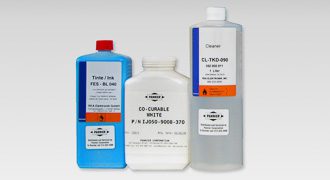
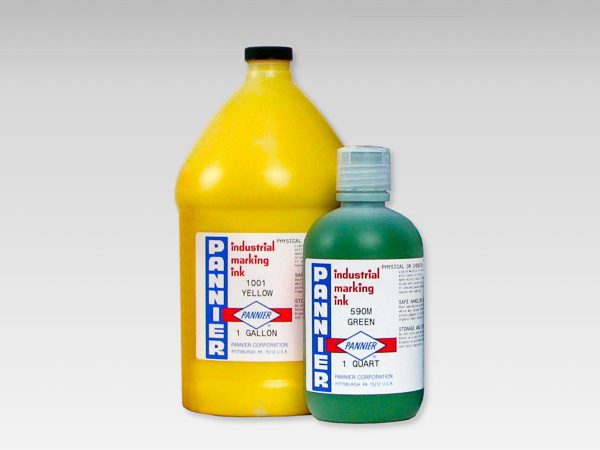
Pannier offers a wide variety of Master Marker inks for printing plastics, metals, and porous surfaces. Let us help you find an ink to mark nearly any material in almost any condition.
Factors to Consider When Choosing an Ink
Inks are formulated for specific uses, and a variety of factors are taken into consideration to determine the best ink for your application. These are important factors to consider:
- The material being marked and its surface condition.
- The production line speed.
- How fast the ink needs to dry.
- The temperature of the material and its surrounding environment.
- The desired characteristics of the printed mark: temporary/permanent, must withstand heat/fluids/weather/abrasion/etc.
Don’t see the ink for your application? Call us for information on custom inks.
| Grade | Specific Use | Open | Roll | Spray | Stamp | Brush |
|---|---|---|---|---|---|---|
| #3 | marking sheet steel; removable with detergent and water | • | • | • | ||
| #5 | identification of coil weld seams; removable in pickling process | • | • | • | • | • |
| #100 | general purpose ink; slower-drying for use in 4 oz bottles and neoprene ink rolls | • | • | • | • | |
| #127 | marking clean aluminum and aluminum with a slight oil film | • | • | • | • | |
| #127½ | marking clean aluminum and aluminum with a slight oil film; fast-drying | • | • | • | • | • |
| #570 | permanent marking on clean metals such as brass, copper, iron, and steel | • | • | • | ||
| #1001 | general purpose ink; galvanized steel, austenitic stainless steel | • | • | • | ||
| #2001 | spray marking on hot steel (800°F to 1600°F) before steel cools down | • |
| Grade | Specific Use | Open | Roll | Spray | Stamp | Brush |
|---|---|---|---|---|---|---|
| #570 | marking plastics, specifically polyethylene | • | • | |||
| #590 | permanent marking on PVC; acceptable marks on styrene and ABS plastics | • | • | • |
| Grade | Specific Use | Open | Roll | Spray | Stamp | Brush |
|---|---|---|---|---|---|---|
| #4 | lumber and wood products, paper | • | • | • | • | • |
| #400 | corrugated containers, paper bags, paper tape, labels | • | • | • | • | |
| #1081 | permanent marking on natural and synthetic fabrics; withstands washing | • | ||||
| #1083 | permanent marking on natural and synthetic fabrics; withstands washing | • | ||||
| #1150 | general purpose ink; for use in 4 oz bottles and neoprene ink rolls | • | • | • | • |